Trade in wild animals for pet keeping causes animal suffering and puts a strain on rescue centres. This dashboard aims to present a holistic picture based on publicly available data.
Pet population (by number of animals)
The European Pet Food Industry Federation's (FEDIAF) 2021 data is represented here. Data collection on the number of animals kept as pets in the EU is not comprehensively collected by authorities. Data is however critical for animal welfare reasons but also because the trade and keeping of wild animals as pets has been linked to the spread of zoonotic diseases and invasive species. This data set covers overall pet ownership, including cats and dogs. Given they are the main group of pets owned, it is important to keep in mind that animal to animal transfer of zoonotic diseases also plays a key role in the health risk that the pet owners face.
Estimated total number of wild species traded for pet keeping in the EU
Data collection on the species of wild animals kept as pets is not comprehensively collected by authorities. For most countries it is unknown which species of wild animals are traded for pet keeping with the exception of Germany. The German data is an analysis of exotic pet retail trade (Pro Wildlife, 2020) in the country and updated by Aguayo & Carpenter in 2024, totalling more than 2,000 species. Germany is the largest consumer market for wild animal pet keeping which makes this database a good baseline for the types of species traded within the EU. The German dataset includes CITES and non-CITES listed species.
Rescue centres and sanctuaries partners: total number and their capacity
This data only includes rescue centres that are part of the European Alliance of Rescue Centres and Sanctuaries (EARS) network, with capacity expressed in average number of individual animals. There is no centralised EU database on genuine wild animal rescue centres or sanctuaries. Rescue and sanctuary capacity in the EU is limited. However, the need to take in wild animals that were once kept as pets is growing.


The trade of wild animals as pets is a growing threat to biodiversity and conservation efforts. The wild animal pet trade and the keeping of these animals has led to the introduction and spread of invasive species and the spread of devastating wildlife disease.
Number of CITES listed species traded in the EU as pets
CITES (the Convention on International Trade in Endangered Species of Wild Fauna and Flora) is one of the key data points for understanding the species and number of wild animals traded as pets in the EU in the past decade (2014-2024). However, only around 10% of all wild animal species are listed in CITES, which means that many species in trade are not being monitored.
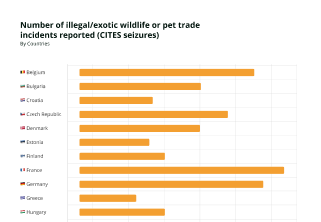
Number of illegal wild animal trade incidents reported (CITES Seizures)
Data on seizures conducted for animal welfare reasons are very difficult to obtain. CITES seizures is an important data point that helps determine the number of wild animals traded in the EU. Data is based on the 2022 TRAFFIC seizure report, which shows that around 20% of confiscations are related to live animals.
Number of wildlife trafficking arrests and convictions
SWiPE data provides an overview of Member State frequently reported offences for illegal wildlife trade. Reported data may overlap in part with the reported CITES seizures. As the 2023 SWiPE report states, "most wildlife crimes go unpunished or undetected", indicating that this is only a limited insight on what is really happening in the EU.
Number of wild animal species at risk of extinction traded as pets in the EU
The International Union for Conservation of Nature (IUCN) maintains a database containing wildlife populations assessments and the risk a population faces to become extinct. For the purpose of the dashboard only species traded as pets in the EU and that are classified as Vulnerable, Endangered or Critically Endangered by IUCN have been included. Data was collected from the IUCN website in the Spring of 2025.




Zoonotic disease reporting by the European Food Standards Agency (EFSA) is mostly focussed on animals used for agricultural purposes. However, the wild animal pet trade has been identified by The Intergovernmental Science-Policy Platform on Biodiversity and Ecosystem Services (IPBES) as a driver of increasing pandemic risks. Research has identified 70 different "exotic" pet related zoonotic diseases in the EU, and between 2015 and 2019, AAP rescued captive wild animals that were susceptible to over 120 zoonotic viruses, bacteria and parasites.
The lack of testing of wild animals kept as pets and gaps in the monitoring of the trade puts the health of EU citizens at risk.
For the purpose of this dashboard, we focused on three zoonotic diseases common in wild animals kept as pets. Note that the data is not specific to wild animals kept as pets, instead, it reflects the data reported by EFSA in 2023, which is mainly focussed on animals used in agriculture.
For the West Nile Virus (WNV), we used the 2023 data from the European Centre for Disease Prevention and Control (ECDC), which covers equines and birds. EFSA does not cover these species. However, they are a key vector of WNV transmissions.
Zoonotic disease, instances of:
- Salmonella (from animals)
- Lyssavirus (animals)
- West Nile virus (horses and birds)



Explore comparative data across all 27 EU Member States — including rescue centres, exotic species, threatened animals, and more.