
Data on trade and zoonoses
Our report and dashboard outline the risks of Europe’s exotic animal trade for pet keeping to animal welfare, biodiversity, and public health. The dashboard presents the trade in numbers across Europe, with Germany standing out as a key Member State that does not have a Positive List and has high levels of trade.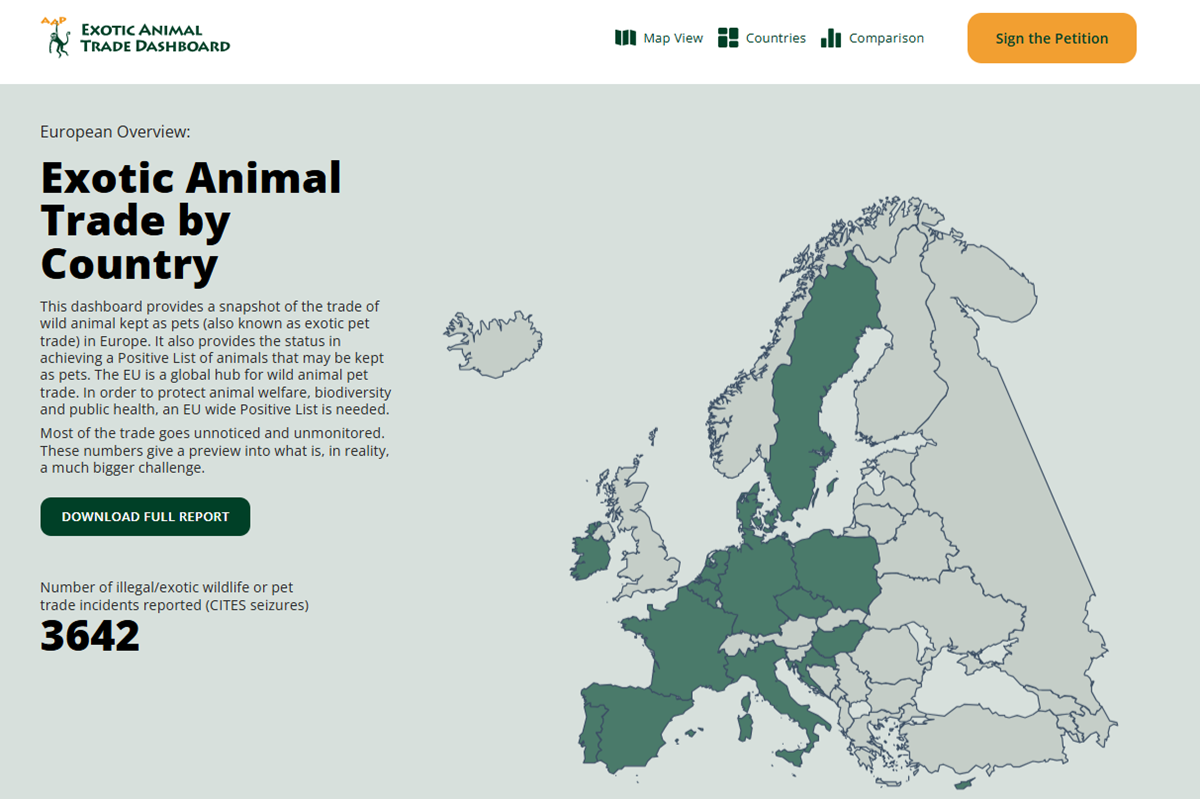
The campaign #WildAnimalsNotPets aims to highlight the potential risks of the wild animal trade so that the next pandemic is not due to a zoonotic disease. An estimated 70 “exotic” pet related zoonotic diseases have been found in the EU. Between 2015 and 2019, AAP rescued wild animals previously kept as pets that were susceptible to over 120 zoonotic viruses, bacteria and parasites. Among the rescued stray animals – formerly kept as pets – the prevalence of zoonoses was a staggering 50%.
The EU already spends an estimated €12 billion annually to manage invasive alien species. Many of them end up in Europe as a result of the wild animal trade. The new report and dashboard show that the EU needs a Positive List and budget to monitor and enforce it.
We should all be alarmed by the fact that Europe is a global hub for the trade of wild animals for pet keeping. This is not just a moral and ethical issue whereby wild animals are traded in appalling conditions. It contributes to the global biodiversity crisis and presents a major public health risk. Our dashboards and report clearly show the need for an EU Positive List coupled with adequate financing for implementation.
Devrol Dupigny, Head of Public Policy, AAP
Call for an EU-wide Positive List
The #WildAnimalsNotPets campaign calls on the EU Commissioner of Health and Animal Welfare to make a Positive List legislative proposal in the current mandate. A Positive List already received support from Parliament (November 2022 Resolution) and Council (May 2022 AGRIFISH Council) and it was one of most publicly endorsed ideas during the Conference on the Future of Europe.
So far, eight EU Member States (Belgium, Croatia, Cyprus, Italy, Lithuania, Luxembourg, Malta and the Netherlands) have implemented a version of a Positive List. Four others (Finland, France, Slovenia and Spain) already have a legal basis in law for a Positive List. Action on a Positive List is missing in 15 Member States. The inconsistent approach has resulted in different lists and contributes to further market fragmentation.
This launch is more than just a report, it is a call to action. As a animal welfare organisation operating two major rescue centres we’re at the forefront of this animal welfare crisis. The science is clear, the exotic animal pet trade causes harm to animals, people and our planet. It’s time to act, there is political will to give these animals and EU citizens a positive future. What we need now is a bold legislative follow-through. We should not wait for another incident, like a pandemic, to compel us to take measures to safeguard the health of EU citizens. Immediate action is necessary to ensure a positive future for Europe
Michèle Hamers, EU Policy Officer, AAP