Uplisting to Release – from illegal trade to Babary macaque protection, November 25, 2025
AAP Animal Advocacy and Protection, the National Agency of Waters and Forests of Morocco, and a research conducted by criminologists from Utrecht University showcased at CITES CoP20 in Samarkand, Uzbekistan, that CITES protection in combination with local action resulted in a decrease in illegal EU Barbary macaque pet trade.
The turning point for Barbary macaque conservation was in 2016 when the species received the highest protection under the Convention on International Trade in Endangered Species of Wild Fauna and Flora (CITES). Additionally, through the Born to be Wild project, AAP and the Moroccan government worked closely together to address the illegal trade at the source, resulting in the release of 15 Barbary macaques in the October of 2025.
Dr. Latifa Sikli from Morocco’s National Agency of Waters and Forests stated, “The Barbary macaque project shows what can be achieved when international agreements are paired with strong national action. The uplisting was a turning point, and the coordinated response allowed the species to truly benefit.”
Eva Schippers, Head of Rescue and Rehabilitation at AAP, noted, “Coordinated political will, enforcement, and education have significantly reduced pressure from the pet trade. Improvements in welfare and protection mean rescued macaques have a real chance to thrive in the wild. This success story can serve as a model for other species facing similar threats.”
Prof. Dr. Daan van Uhm from Utrecht University added, “The Barbary macaque case demonstrates that strong collaboration following a CITES-uplisting can meaningfully lessen pressure from the pet trade. It underscores the importance of the interplay between criminalisation, enforcement, public awareness, and community-driven conservation.”
The event also underscored the need for consumer regions, such as the EU, to address the local demand for the keeping of wild animals as pets.
Pet trade threat to wild animals
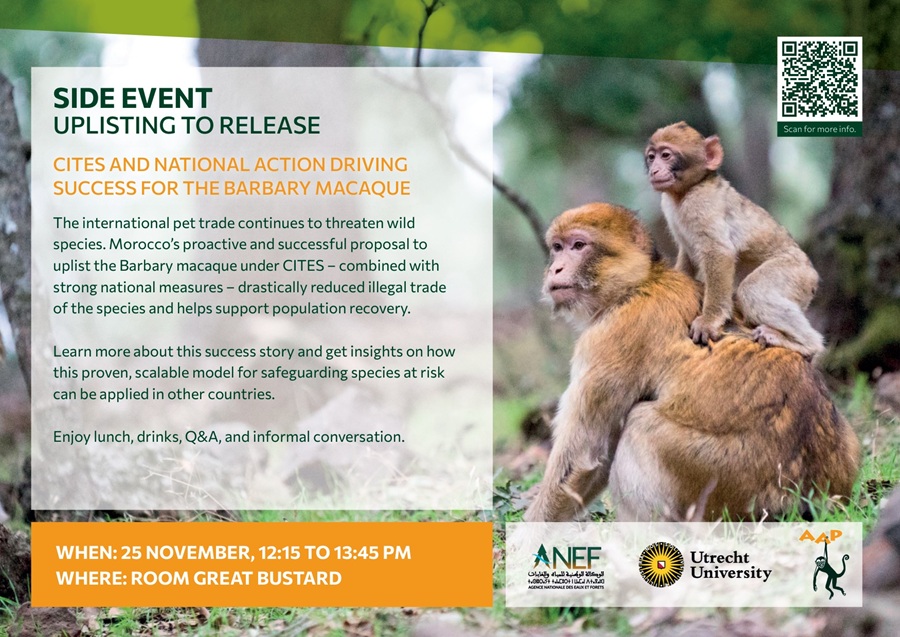
The international pet trade continues to threaten wild animals and drives the decline of many species in their countries of origin. The Barbary macaque (Macaca sylvanus) – once a common victim of illegal trade – offers a rare success story of how coordinated international and national action can make a difference for an endangered species.
This side event explored the impact of the macaque’s uplisting to CITES Appendix I and how it sparked a systemic national response in Morocco. Since 2017, stronger enforcement, public awareness campaigns, and government-led protection of wild populations have helped reduce illegal trade. Conditions for confiscated macaques have also improved, enabling successful rehabilitation and release.
We have presented a new report evaluating the effectiveness of the CITES uplisting and Morocco’s response. The findings include scientific data and policy analysis, and support this case as a replicable model for other species affected by the pet trade. The case demonstrates the importance of combining international agreements with strong national regulation and political will.
The event also underlined the responsibility of consumer countries to reduce demand for wild animals kept as pets. Stronger domestic measures are essential to protect species at risk.
The event closed with an interactive Q&A to reflect on lessons learned and explore how this model can guide and inspire protection efforts for other at-risk species.
Speaker profiles
Dr. Latifa Sikli, Service of Ecology and Wild Fauna and Flora Conservation, National Agency of Waters and Forests, Morocco .
Dr. Latifa Sikli is a Doctor of Veterinary Medicine (DVM) and a graduate of the Hassan II Agronomic and Veterinary Institute. She leads the Service of Ecology and Wild Fauna and Flora Conservation at the Moroccan National Agency of Waters and Forests, where she is deeply committed to protecting and restoring endangered species through management, rehabilitation, and reintroduction programs. Dr. Sikli also serves as a focal point for several international conservation conventions, including CITES, CMS, RAMSAR, Bern, and AEWA.
Eva Schippers, Head of Rescue and Rehabilitation, AAP Animal Advocacy and Protection .
Eva Schippers brings nearly 25 years of experience in animal welfare and behavioural biology through her long-standing work with AAP Animal Advocacy and Protection. Starting her career as a behavioural biologist, she has since taken on the role of managing the Rescue and Rehabilitation Department, where she oversees the care and recovery of a wide range of rescued exotic animals.
Eva has been involved in the Born to be Wild project from its early stages, contributing her expertise in animal welfare and reintroduction strategies. She now leads the rehabilitation and release efforts for Barbary macaques in Tazekka National Park, Morocco—an initiative that blends scientific insight with practical conservation action. Her work reflects a deep commitment to ethical wildlife management and the development of sustainable reintroduction practices
Prof. dr. Daan van Uhm, Professor of Environmental Crime & Associate Professor of Criminology, Utrecht University .
Prof. dr. Daan van Uhm is Professor of Environmental Crime and Associate Professor of Criminology (Open University/Utrecht University). He has conducted research on various forms of environmental crime, including illegal mining in Latin America, wildlife trafficking in Southeast Asia, deforestation in Central Africa, and the criminalization of ecocide in Europe.
Side event Uplisting to Release
Highlighted the Born to be Wild project, where a group of Barbary macaques was successfully released back into their natural habitat in Morocco — a critical step for this endangered species.
Showed how uplisting — moving the Barbary macaque to CITES Appendix I, which bans international commercial trade — combined with strong national protection measures in Morocco worked together to curb illegal trade. Read the report Poaching and trade of Barbary macaques.
Demonstrated how combined efforts of policy work, rescue, rehabilitation, and the release programme made this achievement possible.
Offered a practical example of a species affected by the pet trade.
CITES COP20
The latest CITES Conference of the Parties (CoP20) took place from 24 November to 5 December 2025 in Uzbekistan, bringing together government representatives, NGOs, and other stakeholders from around the world to discuss wildlife trade and conservation.
AAP used this opportunity to (co)host three side events, reaching a wide range of international governments and stakeholders, highlighting practical solutions to protect wildlife and improve their welfare.
AAP and CITES CoP20
Read more about CITES CoP20 and AAP's involvement.