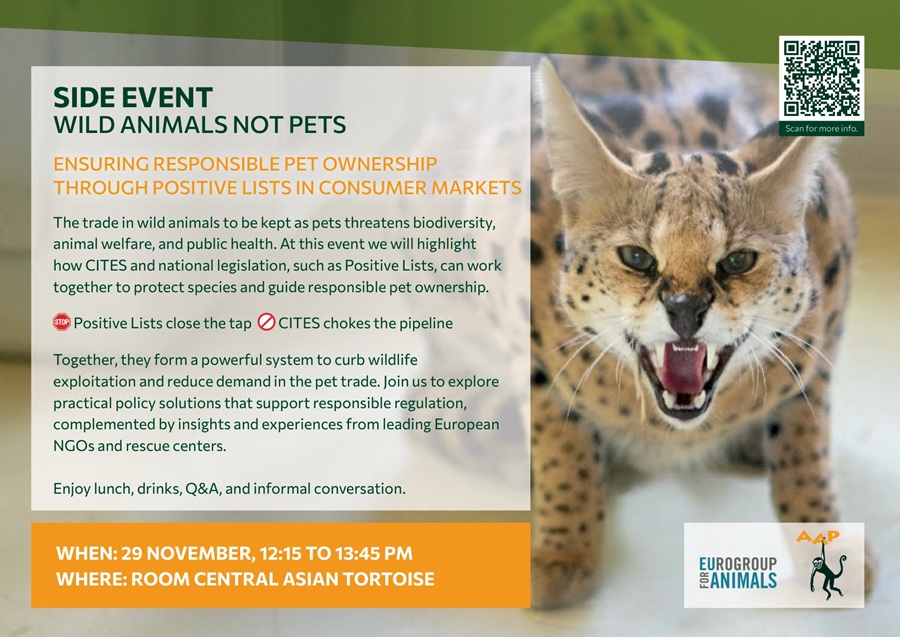
On 29 November 2025, AAP Animal Advocacy and Protection and Eurogroup for Animals cohosted the side event ‘Wild Animals Not Pets: Ensuring Responsible Pet Ownership Through Positive Lists’ during CITES CoP20.
The international trade in wild animals for the exotic pet market poses a growing threat to biodiversity, animal welfare, and public health. This event explored how CITES and national legislation can work together to better protect species commonly kept as pets but unsuited to captivity.
With rising demand for wild animals in private households, current regulatory approaches are often reactive and insufficient to address the scale and complexity of the trade. Positive Lists – which define which species are suitable to be kept as pets based on clear criteria such as animal welfare, ecological impact, and human safety – offer a proactive, science-based solution.
Experts and policymakers have presented national experiences with Positive Lists and discussed how these tools can complement CITES mechanisms by addressing demand-side challenges and gaps in enforcement.
By showcasing successful legislative approaches, the event has provided concrete policy options for Parties aiming to strengthen species conservation, prevent animal suffering, and protect public health. It also highlighted the importance of collaboration between CITES authorities, environmental ministries, veterinary and public health sectors.
This session offered a timely opportunity to reflect on how international and national frameworks can align more effectively to reduce pressure on wild populations and ensure responsible regulation of the private keeping of wild animals.
Speakers profiles
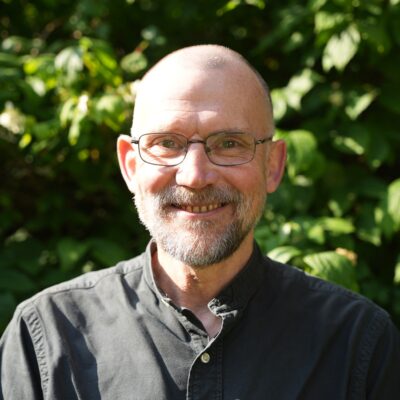
Dr. Mark Jones, Head of Policy, Born Free Foundation.
Dr. Mark Jones trained as a vet at Liverpool University and worked for many years in fish health and disease control, before spending five years travelling extensively and working on rescue and rehabilitation projects for primates, bears, birds, and reptiles in South America and Asia. He has Masters’ degrees in both aquatic and wild animal health, and several years’ experience in the non-government animal protection sector. He joined the UK-based international wildlife charity Born Free in 2014 where he is currently Head of Policy, managing a team focussed on promoting the adoption of progressive legislation and policy concerning wildlife conservation, management and trade, and the welfare of both free living and captive wild animals, at international, national and local levels.
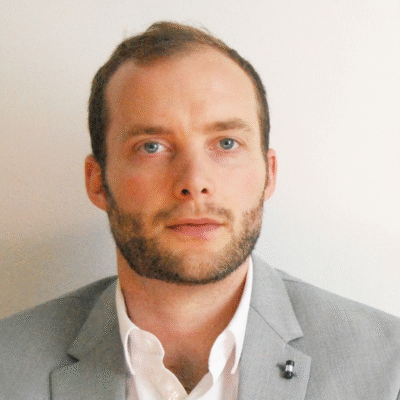
Nicholas Clark, Wildlife Programme Leader, Eurogroup for Animals.
Nicholas Clark was born in the UK, but having lived in Spain and Brussels. He studied zoology and has a master’s in human ecology, where he specialises in using science and multiple stakeholder opinions to help inform sound and responsible policy. Nick has a varied career as a secondary school head teacher, advocate for sustainable development through the social economy and as a wild animals expert at Eurogroup for Animals. He believes that we need to change the way humans use nature, to better value nature for nature’s sake.
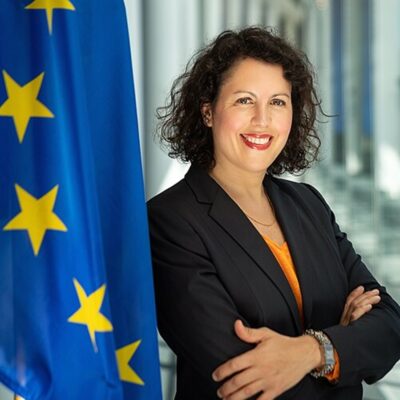
Manuela Ripa, Member of the European Parliament
Manuela Ripa, MEP (ÖDP), is a fully qualified lawyer and represents the Ecological Democratic Party in the European Parliament as part of the EPP Group. She is a full member of the Committee on Culture and Education (CULT) and a substitute member of the Committee on the Environment, Public Health and Food Safety (ENVI), the Committee on Public Health (SANT), and the Committee on Women’s Rights and Gender Equality (FEMM). She also serves as Vice-President of the Intergroup on Animal Welfare and chairs a cross-party working group on sustainable food systems. Her political work is particularly focused on animal welfare, consumer protection, healthy nutrition, and environmental sustainability. In the European Parliament, she has, among other things as the rapporteur for the ENVI opinion on the welfare of cats and dogs, co-rapporteur for the resolution on CITES COP20, and will serve as co-chair of the European Parliament’s delegation to the COP20 CITES conference.
Michèle Hamers, Public Policy Officer EU, AAP Animal Advocacy and Protection.
Michèle Hamers is an animal welfare scientist, specialised in captive wildlife welfare and related policy. She has a master’s degree in animal biology and welfare from the University of Essex in the U.K.. Professional recognitions include European professional biologist, Registered scientist with the Royal Society of Biology and master herpetologist. As subject matter expert who has worked in the captive wildlife field for over a decade, Michèle has testified for government committees and her work has regularly been featured in media. Last year she moved back to Europe where she currently in Brussels to work on EU policies related to the wild animal trade.
Side event Wild Animals Not Pets in short
Looks at how the wild animal pet trade puts animal welfare, biodiversity, and even human health at risk.
Shows how CITES and national laws can be combined to better protect species that shouldn’t be kept as pets.
Shares experiences from countries that have introduced science-based Positive Lists to make pet keeping safer and more responsible.
CITES COP20
The latest CITES Conference of the Parties (CoP20) took place from 24 November to 5 December 2025 in Uzbekistan, bringing together government representatives, NGOs, and other stakeholders from around the world to discuss wildlife trade and conservation.
AAP used this opportunity to (co)host three side events, reaching a wide range of international governments and stakeholders, highlighting practical solutions to protect wildlife and improve their welfare.
AAP and CITES CoP20
Read more about CITES CoP20 and AAP's involvement.