The raccoon
in the Netherlands
Information about AAP’s animal-friendly approach
Dealing with raccoons
Whenever raccoons appear in the news, articles and opinions start pouring in about how the Netherlands should deal with them. Raccoons are an invasive exotic species that does not belong in the Dutch environment and can pose a threat to the biodiversity. AAP has been advocating for years that we should take in raccoons, as long as we are dealing with manageable, isolated populations.
When raccoon populations spread into the Netherlands, this is no longer a sustainable and achievable solution. Between 2019 and 2022, AAP has taken in almost 100 raccoons that were taken from Limburg.
In the Questions and Answers below, we explain why we took in the 100 raccoons from Limburg, but also why we have decided to stop doing so in 2022.
We would like to give the raccoons a safe future
Questions & answers - raccoons in the Netherlands
Since August 3, 2016, EU Exotics Regulation 1143/2014 applies to a number of harmful exotic plants and animals – called Invasive Alien Species (IAS). For each species on this list, extensive research has been carried out, particularly into its harmfulness. One of the mammals on this list – the so-called Union list – is the raccoon (Procyon lotor).
As an EU member state, the Netherlands is legally obliged to permanently remove this invasive exotic species from the wild. This is to prevent the raccoon from settling here and causing damage to native species. In the Netherlands, provinces are obliged to monitor raccoons in nature. How they do this is up to them.
AAP fears that this fragmentation does not contribute to an effective approach and advocates a (inter)national policy for invasive exotics. But as long as that is not the case, we urge the provinces to adopt the most animal-friendly policy possible.
This is a moral issue. AAP does not think it is right to kill healthy animals that can’t do anything about the fact that they have been released in Europe. That is why we rescue them and try to outplace the animals. Zoos, unlike most private keepers, are perfectly capable of providing good conditions for raccoons. The animals are very inventive, adapt very quickly and can have a good life in a zoo. If a life in the wild is not possible, we think this is the best alternative. This solution also fits in well with the exotic species regulation, which states that invasive species must be spared all avoidable pain, strain and suffering.
When provinces opt for an animal-friendly approach and choose AAP as a solution partner to care for the animals, it is only reasonable that the costs are (partly) reimbursed. These are our net costs for sterilization, deworming, other medical treatments and checks during the quarantine period, and 30 days of care. Most raccoons stay longer at AAP. Those extra costs are covered by our donors.
In short; the compensation from the provinces does not cover the costs.
In Germany, the raccoon is already officially established and therefore falls into a different category than in the Netherlands. It is no longer realistic that all these animals can be removed, but Germany is obliged to ensure that the animals do not spread to other EU member states, such as the Netherlands (see Art. 19 IAS Regulation).
The risk assessment and approach is therefore different for each country. The raccoon poses a threat to valuable native species in many areas, for example meadow birds and ground-breeding birds that are protected in the Netherlands. AAP therefore supports the policy to prevent raccoons from settling here, but also sees it as its task to advocate for an animal-friendly alternative to shooting them.
No, AAP lacks the capacity to accommodate them —particularly because the outplacement process is hindered by strict regulations concerning invasive alien species—and such an approach contradicts our philosophy. Until now, this hasn’t been an issue: as of 2022, the core raccoon population in Germany only extended as far as halfway through the state of North Rhine-Westphalia.
However, recent research has shown that the habitats of small local raccoon groups in Limburg cross both the German and Belgian borders. This is one of the reasons why, starting in autumn 2022, AAP no longer takes in these animals. Without an international policy, AAP cannot contribute to a sustainable solution. We therefore make an urgent appeal to policymakers: shape EU policy on invasive alien species in a humane and coordinated European manner. Shifting full responsibility to provinces and organisations that care about the welfare of these animals is a stopgap measure—not a solution to halt the further spread of these exotics.
When there are no longer small, local groups of raccoons but a growing population settling in the Netherlands from surrounding countries, taking them in as we have done up till 2022 is no longer sufficient. But even if our rescue capacity and outplacement of animals no longer suffice, AAP is still against culling.
In Germany, where over 200,000 raccoons were shot in 2020, the population is growing by 15-20% annually and appears to be unmanageable. Also, a lot goes wrong during hunting, and other animals (such as badgers) can be killed by mistake. Or animals are merely injured with all the suffering that entails.
AAP hopes for a breakthrough in the field of practical contraception, which is the subject of much research worldwide. However, an ideal solution is not yet on the table.
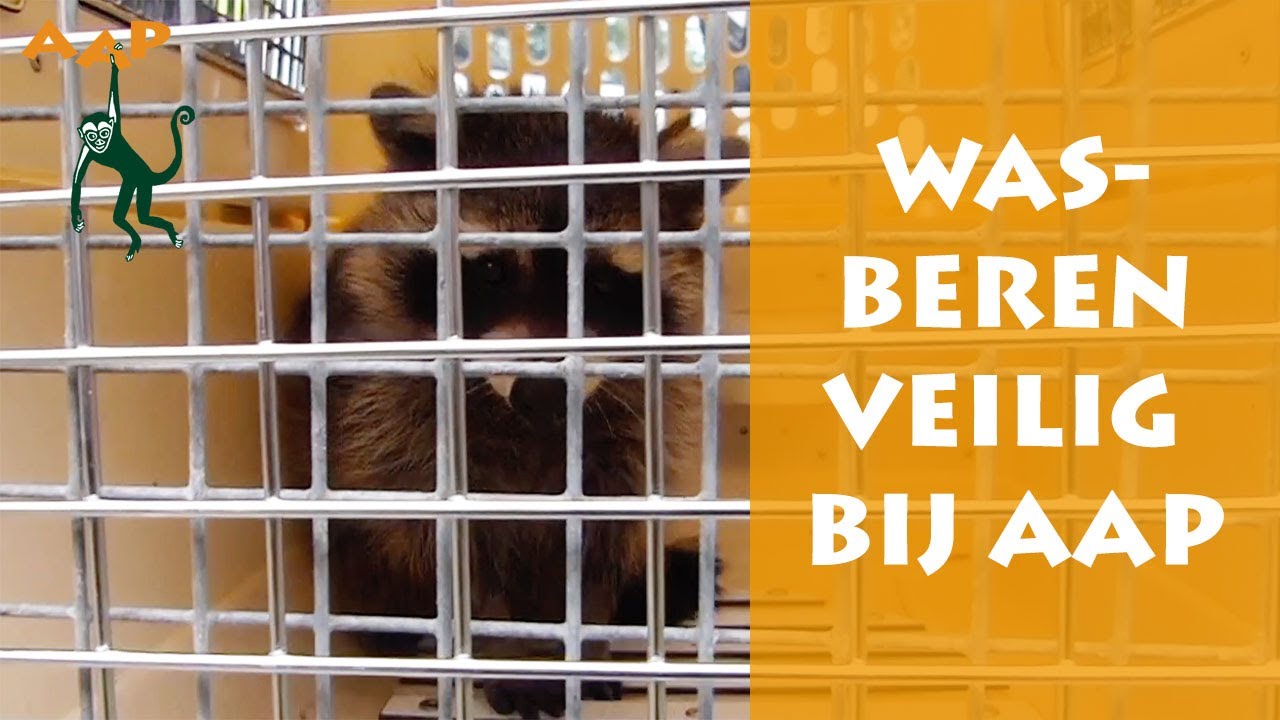
Anyone who sees (traces of) a raccoon can report this with a photo and location on www.wasberenmeldpunt.nl. If it turns out that it is indeed a raccoon, an attempt will be made to catch the animal alive with a trap cage. Should you come across such a trap cage in the wild, stay away from it. The trap cages are equipped with a sensor, so when an animal is captured they will be quickly transferred to a rescue centre.