Exotic
pets
and did not receive proper care.
Exotic pets in the EU
Keeping a primate or some other exotic animal as a pet? You may think that’s a thing from the past, but it is still very common. Like chimpanzee Marria, who lived with a family for years, with appalling consequences. Or serval Xirus, who developed deformities as a result of not receiving proper nutrition and care.
In most EU countries, it is unfortunately legal to keep all kinds of exotic species as pets. In fact, the European Union is one of the largest markets in the world for exotic pets. This leads to several significant problems.
Animal suffering
Pressure on local ecosystems
Loss of biodiversity
Risk to public health and safety
The solution
At AAP, we advocate for the implementation of a Positive List for pets throughout Europe. Such a list comprises animal species that independent experts deem suitable to be kept as pets. All species that are not on this list are automatically not allowed as pets.
We are pushing for more EU member states to implement this instrument and to ultimately create a Positive List for the entire European Union. We are convinced that using such a Positive List is the best way to prevent the suffering of exotic mammals in captivity.
Data on trade and zoonoses
Our report and dashboard outline the risks of Europe’s exotic animal trade for pet keeping to animal welfare, biodiversity, and public health.
The dashboard presents the trade in numbers across Europe, and highlights the potential risks of the wild animal trade so that the next pandemic is not due to a zoonotic disease.
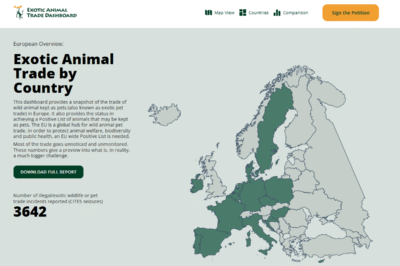
The Dutch positive list for pets
Our work is not over yet, because we want more EU countries to work with such a list. That is why we are simultaneously working towards a European Positive List that applies to all Member States. This instrument could prevent a lot of animal suffering.
The positive list in Europe
A European Positive List is the most effective approach to animal suffering, public health risks and (illegal) animal trade in Europe and beyond. Ensuring that the EU introduces this regulation is one of AAP's main goals.
Results & impact
AAP advocates the development of Positive Lists, both at national and European level. We exchange knowledge with partner organisations across various countries to achieve our goal. Curious to know which EU countries already use a Positive list—or which ones don’t yet? Hover over the map below or tap on a country to see the status for each EU member state.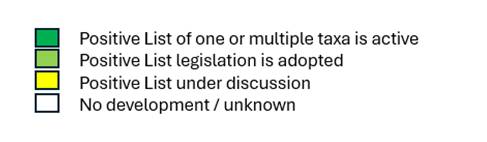
At AAP, Xirus received the professional care he needed to regain his strength. Regular medical check-ups were necessary to monitor his recovery. As a result, Xirus is doing much better now.